레이블이 금석문(金石文)인 게시물을 표시합니다. 모든 게시물 표시

2012-03-04

울진·포항·울산 답사


[울진·포항·울산 답사] 2012.02.29~03.01


<첫째날>

7:40 서울 출발

11:15 영주 부석사 도착 - 성보박물관 개관했음(조사당 벽화 전시)


<박물관 안에 가람 모형도> 

일설에는 화엄사의 華자를 따라서 가람배치가 되었다고 하기도 하는데, 

사진에서도 볼 수 있듯 비슷하긴 하다.


점심

13:30 부석사 출발

14:05 영주 신암리 마애삼존석불 : 봉화 국지리 마애불 및 영주 가흥동 마애 삼존불과 비슷


16:00 울진 봉평비 전시관 (3월~10월 10:00~18:00/11월~2월 10:00~17:00)

                                1) 524년 건립되었다고 추정. 520년에는 법흥왕의 율령반포가 있었음
                                2) 원래부터 비가 정사각형이 아니었다고 생각됨


울진군에서 돈 많이 들여서 만든 모양이다.

이 건물 말고 그 뒤에 한반도 모양의 비석공원이 있어서

유명한 금석문들은 죄다 만나볼 수 있다. 물론 복제품이다.


14:50 성류굴

삼국유사 권3 탑상편에 기록된 신라의 보천태자가 수도했다는 울진국 장천굴로 추정된다.


                                1) 입장료 성인 3천원
                                2) 보천태자가 수도했다는 11광장은 현재 출입제한구역


저녁


<둘째날>


8:10 숙소(포항 오도리 하우스) 출발
                  : 바닷가 바로 인접해있으나 방 개수에 비해 화장실 및 욕실이 턱없이 부족


8:40 중성리비 발견 장소 도착(포항시 흥해읍 중성리 167-1번지, 흥해 중앙교회 근처)


사진에 서 있는 학생 바로 앞 부분에서 발견되었다고 하는데, 

중성리비가 실제 건립되었던 장소가 과연 여기인가 하면 그건 또 확실치 않은 문제이다. 

여기서 조선시대 읍성이 멀지 않다. 그 안에 있었을 확률도 있다고도 본다. 


8:55~9:15 포항 영일 민속 박물관 (과거 흥해읍 동헌이었던 제남헌)


제남헌 바로 앞에 흥선대원군이 세운 척화비가 있다.


암각화로 유명한 포항 곤륜산에서 발견된 척화비라 한다.

금석문이 쏟아지는 대단한 곳이다.. '-'


척화비 옆에 해석판이 있는데, 해석이 좀 틀렸다. 바로잡는다.

우리의 만대 자손들에게 경고하노니

서양오랑캐가 침범하는데

싸우지 않는 것은 곧 화친하자는 것이요

화친을 주장하는 것은 나라를 파는 것이다.

병인년에 쓰고, 신미년에 세우다. 


(훈장님과 학동이 공부하고 있는 책은....영어책이었다..-_-)


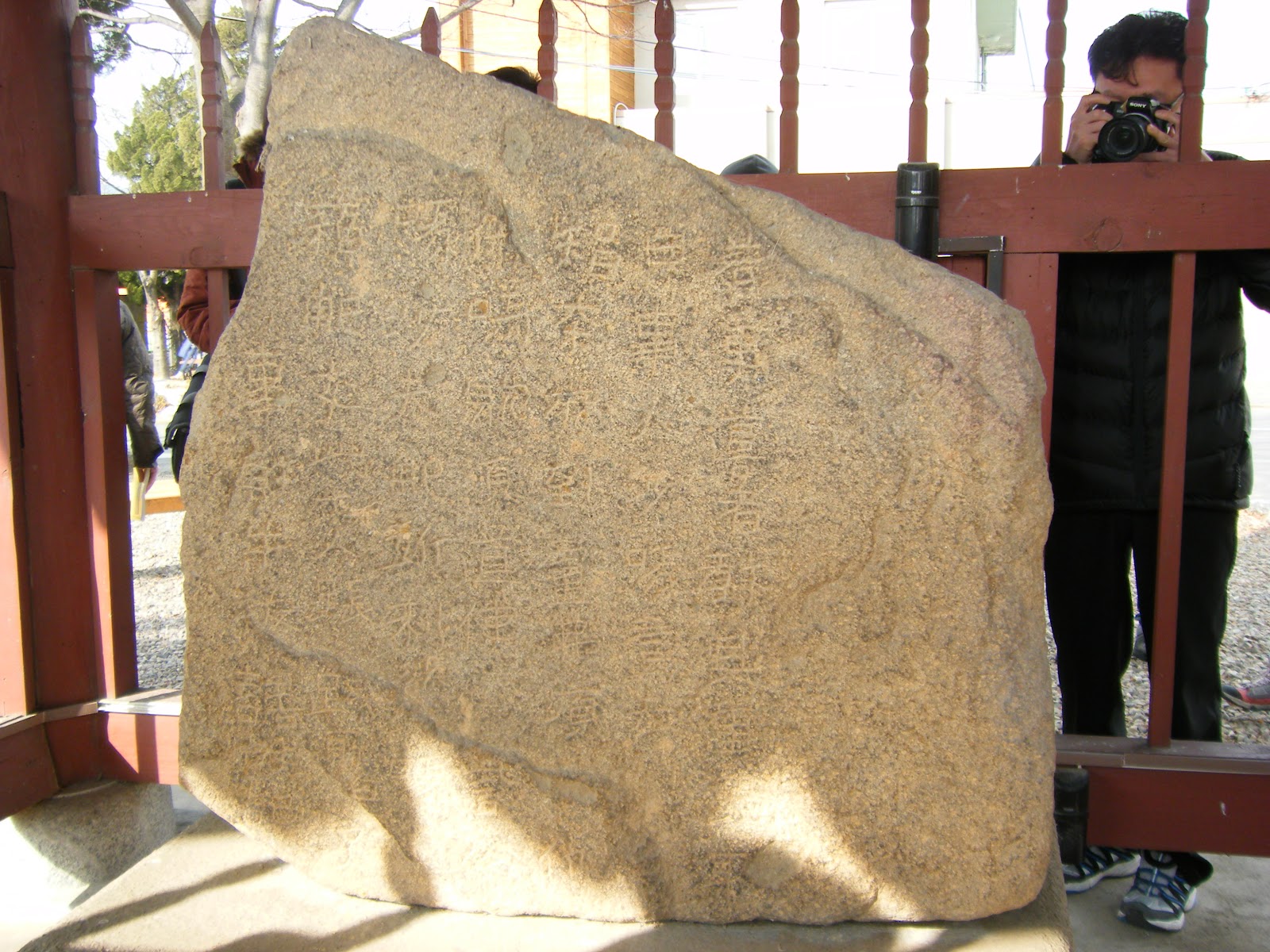
9:35 냉수리비 (신광면사무소)

             1) 503년 설 유력하나, 501년 지증왕이 여기에서는 갈문왕으로 나타나고 있는 문제


10:05-11:05 남미질부성(추정)


                                        : 지역주민들의 경작활동에 의해 토성 파괴가 이루어지고 있음


12:45-13:20 점심

13:45-14:15 울산 처용암 : 1) 정말 처용과 관련된 유적인지는 고심해봐야 함.
                                      적어도 삼국시대의 울산 지형은 매우 달랐을 것.
                                      지금보다 해수면이 높았다.
                                      2) 근처 반구동 유적 - 경주 동천과 울산 태화강의 합류지점
                                                                      신라의 외항 역할


15:10 천전리 각석-> 반고사지->반구대 암각화
                                    : 데이트 코스 or 등산 코스로 좋음


건너편 산에서 바라본 천전리 각석이다.

점점 앞으로 기울어지고 있다고 하니 다음에는 엎어져서 볼 수 없게 될 수도 있다고 한다.

개인적으로는 기마 행렬도를 눈으로 확인하고 싶었는데,

보호하느라 약간 거리가 떨어져 있어서 그런지 몰라도 육안으로 확인이 불가능했다. 
                                 

17:20 울산 암각화 박물관(입장료 무료, 9:00~18:00)

                                     1) 천전리각석과 반구대 암각화 모조품 전시중
                                     2) 도록은 없고 시집을 팔고 있음(-_-) 그 외 기념품 몇 가지 판매

17:45 서울로 출발

18:15 경주

19:50 칠곡휴게소 출발


2011-01-31

[부여]Buyeo National Museum


Buyeo National Museum http://buyeo.museum.go.kr/
The best place where visitors can feel flavor of Baekje


Buyeo was the last captial city of Baekje Kingdom, so the prosperity of the culture remains in there.

Particulary, Buyeo National Museum is commonly listed as one of Korean main museums, because of its many treasures.


A mural in NeungSan-Ri Tomb No.1
 능산리고분군(扶餘陵山里古墳群)

This painting of White Tiger(白虎) was found in a tomb on a mountain in NeungSan-Ri, Buyeo.

There are seven tombs in the mountain, they are believed as the Baekje royal burial ground.


The Village of Bronze Age in SongGuk-Ri, Buyeo (Replica) 

Buyeo is nestled against the liver Geum, so early villages could develop.

SongGuk-Ri Village(扶餘 松菊里 先史聚落址) is presumed to have been constructed through B.C.7~6.

This famous village of Korean Broze Age influenced Japanese Yayoi Culture.


A music instrument which made of bronze

Left: LiaoNing(the northerneast of China) style bronze dagger
Right: Korean Style bronze dagger 

Molds


SongGuk-Ri Style Earthware


These earthware were excavated from the ritual remain in Nonchi, Buyeo (扶餘 論峙祭祀遺蹟)


The Epitaph of Buyeo Yung(扶餘隆)

Buyeo Yung was the last crown prince of Baekje Kingdom.

After Baekje was collapsed by Tang and Silla, he was taken to Tang(唐), and died in there.

In mountain Beimang(北芒山) of Henan, China, the epitaph of Buyeo Yung still  remains.

The epitaph of Buyeo Yung in Buyeo National Museum is a replica.


百濟昌王銘石造舍利龕(National Treasure No.288)

"百濟昌王十三秊太歲在 丁亥妹兄公主供養舍利" are carved on the stone case.


This stone memorial stone was found in the south of mountain Buso, Buyeo.

It was constructed by SaTaekJiJeok(砂宅智積) who was a powerful man in politically.


부여 왕흥사터 사리그릇

When King YuiDeok[?~598] constructed a wooden pagoda for his two dead princes,
these little containers were also put into the pagoda.


諸法從緣起
如來說是因
彼法因緣盡
是大沙門說


Everything is formed by its cause
Buddha told the principle
Everything dissipates along with the principle
This is the instruction which the great teacher gave.


The structure of Buddhist temple in Korea (Goguryo, Silla, Baekje, Unified-Silla)


2011-01-19

[공주] 송산리고분군, 무령왕릉


The Fieldtrip to Gongju(2)


The next destination is the Tombs in Songsan-ri(宋山里古墳群).

Songsan-ri where 7 tombs of Baekje are located in is apart from Gong-sanseong(公山城) in the west.

The sights became famous for excavation of the Tomb of King Mooryeong(武寧王陵) in 1971.

The Tombs in Songsan-ri(宋山里古墳群)


A look inside the maquette of Tomb No.6 (宋山里6號墳)

Among the tombs, worth noting is Tomb No.6, because of its mural paitings.

Its mural features Four Deities- Cheongryong(靑龍), Baekho(白虎), Hyeonmoo(玄武), Jujak(朱雀)

These murals was painted simply after some part of walls was daupted with mud,

while murals of Tomb No.1 of Neungsan-ri(陵山里1號墳; it is also a tomb of Baekje) was painted directly

on properly faced stones.

Tomb No.6 of Songsan-ri and Tomb No.1 of Neungsan-ri are the only Baekje tomb has murals.


The murals features Four Deities of Tomb No.6


The hall for a oil lamp (maquette)


Then-picture when Tomb of Muryeong(武寧王陵) was discovered

Tomb No.7 of Songsan-ri became known as the tomb of King Muryeong(461~523) for his name on a stone board.(epitaph)


아래는 송산리 고분군 모형관에 있는 매지권(買地卷)과 묘지명(墓誌銘)인데

다음에 이어지는 공주박물관의 번역과 조금 다른 부분이 있어서

양측을 다 싣도록 한다.


매지권

간지도


왕의 묘지(墓誌)

왕비의 묘지(墓誌)


National Gongju Museum


Gongju National Museum is close to tombs of Songsan-ri. (website : gongju.museum.go.kr)

The museum has two permanent exhibition halls; hall for Tomb of King Mooryeong and hall for ancient culture of Chungcheongnam-do


In the exhibition hall for Tomb of King Mooryeong,

visitors can see a restoration of Tomb of King Mooryeong.


Wooden coffins of King and Queen

the restoration of entrance of the tomb


necklace made of charred woods and gold.