레이블이 In English인 게시물을 표시합니다. 모든 게시물 표시

2013-08-22

National Museum of Korean Contemporary History


National Museum of Korean Contemporary History


National Museum of Korean Contemporary History, opened in the winter of 2012, is right across from the Gyeongbokgung Palace in Seoul.

Its premises belonged to Ministry of Culture, Sports and Tourism 
before the museum was established.

As a recently-built museum, it is very clean and well-designed.
Especially, Presidential Room, where visitors can sit on the chair, exhibits its geographical advantage well. 

Please, look at the following picture.


Through scenery from the window, visitors can see the Blue House(Korean presidential palace) behind the Gyeongbokgung Palace at the foot of Mt.Inwangsan


The museum covers Korean history from 1876 to the present day.
1876 was the year that the first modern international treaty for Joseon was signed with Japan, then Joseon gradually headed for a downfall.


Republic of Korea(South Korea) was established in 1948 after the liberation of 1945.
That was not an easy-going compromise, 
there had been a number of terrorism -sometimes resulted in slaughters of innocent people, for example, April Third Incident - between left and right wings since the liberation. 


If you like to learn more about this period, I'd like to recommend you look the webtoon titled 'Operation Chromite' (http://comics.nate.com/webtoon/detail.php?btno=55715)

This webtoon, focused on an ordinary family, has been published online and gained popularity from internet users.

Its cartoonist, Yoon Taeho, attained fame with previous webtoon titled 'Misaeng', which also converted into a movie afterwards.


Personally speaking, I was born in 1986.
The year I was born was the last period of Jeon Doowhuan who was the last dictator of South Korea.
There was an immense nationwide protest against his dictatorship throughout June of the following year(6월항쟁, 六月抗爭)
It is probably impossible for me to imagine how my parents endured that time.
They were a poor newly-wed in their late twenties, and had two babies to bring up.

Meanwhile, I am the very beneficiary of the miracle of Han River.
In 1988 when I was three, South Korea held the Seoul Olympic.
Industrialization that had been driven by the government since 1960s just started to get reward back to Koreans.

My generation was at the end of governmental oppression.
When I was in the lower grades in elementary school,
I did something like a mass game that was similar to that of the present North Korea
and also had to gather up in the school ground every monday morning in order to listen to principal's speech.

On the other hand, we were a generation of new flow.
Unlike our previous generation, we didn't pay attention to the ideology, right or left.
I am class of 05, we elected the first student representative who had no political preference and that was shock to our seniors.
In short, we were the first generation that derailed dichotomy whether right or left.
However, that didn't mean we made head against the existing rule.
We were more familiar with capital than ideology and politics.
That's the reason why we were the first students who accepted franchise stores on campus with no repulsion.


The museum is currently holding a special exhibition on Korean War(1950-1953)


the course of the Korean War


documents as a result of armistice agreement of Korean War

replicas are available for visitors to read

the inside of the special exhibition


the document of armistice agreement contains five representatives' autographs.
However, there were no name from South Korea, 
since Korean army was controlled by the US at those times.

That's why the Korean War is called a proxy war.


Even though Koreans have made numerous errors in our contemporary history, 
democratization and economic development have been substantially achieved. 

Still has a long way to go... 

So many open sores are left behind our rapid economic and political developments.


2013-08-10

Sorok Island, Colony of a Colony

This is my statement of Youth Forum in which I participated on 24 July, 2013
The Youth Forum was one of the programs of the 5th International History NGOs Conference(http://www.historyngo.org/), and seven international students gave presentations on the theme of Regional Cooperation and Historical Reconciliation in East Asia

---------------------------------------------------------------------------------

Sorok Island, Colony of a Colony[1]


South Korea is currently one of advanced countries in the world, but the history Korea has gone through was by no means ‘smooth sailing’. The Joseon Dynasty, the last dynasty of Korea, was officially annexed to the Japanese Empire in 1910, and Japanese ruling had lasted until it surrendered to the Allied Forces in 1945. However, despite the liberation, Korea was divided into two parts along with the international circumstance of the Cold War, which led to Korean War(1950-1953). In the end, two Koreas were respectively established in the North and the South, and have been following different social and economic systems.

Thus, Korean modern history is too complicated to be told as a single story, since many different interests are entangled in the Korean modern history. Even though, Korean media reports dealing with historical issues are generally emotional and nationalistic. In particular, they tend to emphasis on brutalities of the Japanese Empire. Such a provocative media report is appealing to most Koreans, and Korean people’s animosity towards Japan becomes more expanded. This situation is believed to become much stronger in our society which brief and instant information is preferred. In this regard, the following story of Sorok Island will give a deeper insight on Korean modern history.

▲ the island had been absolutely isolated before a bridge was built in 2009 


Sorok Island, literally meaning of ‘little deer island’, is off the southwestern coast of Korea, and it has been a prime example of a leper colony of Korea since the Japanese Empire established it in 1916. Leprosy, known as Hansen’s Disease to Koreans, is a chronic infection caused by bacteria Mycobacterium Leprae discovered by the Norwegian physician Hansen. For decades, however, leprosy had commonly been believed to be highly infectious, and lepers have also received disdainful treatment from the general public because of its disfigured appearance. 

▲ a scene from movie 'Benhur'(1959)
mother and sister of the main character suffered from leprosy

▲ a scene from Korean TV drama 'Heojun'
the two films' huge success perpetuated the stigma associated with leprosy

However, leprosy is neither a highly contagious disease nor a genetic disease and it can be also cured with a sustained course of antibiotics, yet the island had been isolated before the building of a bridge connecting the island and the mainland in 2009. On the island, several old buildings including the only one Japanese shrine left in the Korean peninsula are well preserved for the purpose of history education.


         Most Korean social media reports show narrative style as follows[2]; Sorok island started its history of a leper colony under the Japanese Empire. The patients were forcibly ferried to the island from all over the Korean Peninsula, and compelled to be confined and sterilized to prevent leprosy from spreading. The buildings like an autopsy room, a sterilization room and a detention barrack still remain on the island, and show visitors how miserable their lives were.

▲ autopsy and sterilization were conducted in this building

 In addition to this, patients also had to labor from dawn to dusk. As the Pacific war was intensified, exploitation was getting more vicious to the island. Patients provided timber and pine resin for the Japanese Empire. A Japanese shrine was also erected on the island, so everyone had to pray there, regardless of their religion. In particularly, Masasue Suo, the fourth hospital director, was notorious for cruelty like torture or beatings. He even erected a statue modeled after him on a hill to which patients were forced to bow every morning. In the end, his tyranny ended when an outraged patient stabbed him to death. 
▲ patients bowing to the statue of Suo

This is how Korean media tell a history. The information above is not altogether false, but such an approach would be dangerous, because readers may think that all problems were caused by Japanese. Above all, it is problematic that the story rules out the history after the liberation in 1945.

After the liberation, Japanese staff withdrew from the island and the patients started to demand autonomy. The Korean staff, struggling for power, called up nation’s police to put them down. It led to a slaughter of about one hundred patients. After that, the corpses were even burnt with pine resin that patients had collected during the Japanese ruling. This incident had been silent before it was officially memorialized when the remains were excavated in 2001. 
▲ The history concerning the slaughter of 1945 engraved on the monument is not lucid.

Except for this slaughter, more cases like the incident of Bitory island[3] and Oma island[4] have been reported but soon forgotten from people’s minds. The prejudice and misunderstanding against lepers are believed to be the main factor of a series of the persecution has happened to them.[5]

In East Asia, lepers were originally not the object of quarantine, and neither they were in Japan.[6] The idea of confining lepers to a specific space was introduced to the East Asia along with the trade with Western powers. Western people regarded leprosy as a nemesis of oneself based on a biblical worldview. The Japanese Empire, mimicking western powers running many colonies all around the world, accepted the new concept of ‘sanitation’ as a meaning of civilization and modernization. For these reasons, Japanese Empire legislated for domestic segregation of lepers in 1907, which had influenced on Japan until 1996. Additionally, Japanese policy towards leprosy patients was based on Eugenics which had broadly implemented in western countries from 1910s to 1930s. Eugenic saw the lepers as the object of eradication, therefore compulsory sterilization and abortion were justified. While the scientific reputation of eugenics started to decline in the 1930s, it became more brutal in Japan and its colonies. The reason must be World War II which was intensified throughout early 1940s, and it brought in the forced closure of hospitals that western missionaries had operated in Korea by Japan. Also, Sorok leper colony turned into kind of a penal colony where autonomously leave and escape was not allowed.

What is interesting is that prejudice and persecution against leprosy patients had lasted in Korea and Japan until quite recently, despite the recommendation of WHO proposing the outpatient treatment in the early 1960s. In Japan, the incriminate quarantine policy was abolished in 1996, and many patients sued the government for compensation and they won it in 2001. On the other hand, Korea abolished it in 1963 due to financial difficulties, but patients have not been compensated by the government. Act on Fact-Finding of Incidents Related to Patients of Hansen’s Disease and Support for Living of Victims was implemented in 2008, but actual compensation has not been conducted yet.

I shall finish with a recondite story of Zhenkichi Hanai who was the hospital director of Sorok island during the 1920s. He was admired for increasing autonomy of the patients by granting freedom of religion and living style and imposed reasonable amounts of labor on them. After he died, patients built a stone monument for him. During a period of eliminating the remnants of the Japanese imperialism, the patients hid the monument underground and later placed it in its original spot.
▲ the stone monument for Dr.Hanai


[1]Primary sources of this article are :
Junko Nakagawa, “The One Study of Hansen’s Disease in Japan” Kukmin University, 2009.
National Sorok island hospital, The 80 year-history of Sorok Island : 1916~1996, 1996.
Korean Leprosy Institute, The History of Leprosy in Korea, 1988.
[2]Wang-gu Lee, “The Japanese Empire’s Tyranny Left in a Prison Built by Forced Labor of Lepers”, HangukIlbo, March 29, 2010, Culture Section, Online edition, (http://news.hankooki.com/lpage/culture/201003/h2010032922404786330.htm);
Jong-chan Oh, “Confinement and Sterilization of the Patients of Hansen’s Disease…Learning Pains of Sorok Island”, Joonang Daily, November 14, 2012, Society Section, Online edition. (http://article.joins.com/news/article/article.asp?total_id=9879299&cloc=olink%7Carticle%7Cdefault)
[3] An incident that local residents slaughtered the patients who tried to cultivate Bitori Island in 1957. The exact number of victims has yet to be reported.
[4] Although patients of Sorok island reclaimed Oma island to build new settlements from 1962 to 1965, the government didn’t grant the land to the patients but to local residents.
[5] The false belief of the rumor that eating a child cures leprosy can be seen in the media reports of disappearance of five children in 1992.
[6] For example, according to historical documents, the Joseon Dynasty made every effort to cure lepers. Also, In Japan, it was not strange to see many lepers begging for money at temples and shrines or wherever people gathered.

2013-05-27

Sunchon National University Museum(국립순천대학교박물관)


순천대학교 박물관
Sunchon National University Museum

The museum was established in 1987 as the first museum of the eastern Jeolla province.

There are many exhibit halls and its collection is specialized in the ancient period of Korea(before the 10th century)

this museum is the best place to learn about the eastern Jeolla province, which has different culture with that of the western Jeolla. but the culture of the eastern Jeolla has a similarity with Gyeongsang province which located right next to it. 

<검단산성>
In particular, a hall dedicated to Geomdan fortress of Sunchon (순천 검단산성 順天 劍丹山城)is important to the Baekje's history


the stone fortress was built during the sixth century by the Baekje kingdom. 
through excavation, people unearthed a lot of remains and relics from the fortress.
as a result, it was designated as a historical site of Korea in 1999 


the photo is a replica of a large well, found in the fortress.
it is 890 cm in length, 480 cm in width


a wooden dipper intact was also unearthed.


This coiled earthenware bottle was also excavated from the fortress. 


<고인돌>
the following picture shows understructures of dolmen


In Korean dolmens, stone daggers were often found
putting a dagger in the grave is believed to have a ritual purpose driving evil spirit off from the grave.


two people praying in front of a huge stone dagger were carved on Orimdong dolmen of Yeosu, which shows ancient people's belief toward the stone dagger.


<가야 토기>
The museum also houses a lot of earthenware potteries dating to the Gaya period


Eventhough the eastern Jeolla currently belongs to Jeolla province of Korea,
as I mentioned above, it has a close correlation with the south-east area of Korea, the South Gyeongsang. this area was ruled by Gaya before the fifth or sixth century


two pottery  in the picture above were chamberpots of Baekje men

<마로산성>

Maro fortress is located in Gwangyang
it is believed that it had been used from the sixth century to the 10th century. 


remains of collecting wells of Maro fortress

what drew my attention was these earthen horses.

they were found in the ritual site of Maro fortress.


interesting thing was that the horse didn't have their head which means they were decapitated.

but the horses on display have their head because the museum assemble them back again.

decapitating a horse conducted when people held rites as a sacrifice.


Sunchon University Museum 
http://museum.sunchon.ac.kr


2013-05-19

The Road of Chusa Kim Jeonghee (Jeju)


Jeju Island, Korea (May 6, 2013)


Jeju Island, well-known scenic spot of Korea, is also a place having memories of Chusa(Kim Jeonghee 1786-1856)


Chusa was a Confucian scholar and artist of the Joseon Dynasty. 

He was a member of royal family, and was bright since he was a child.

He could also travel Qing China as the dependant of diplomat when he was young. 

this experience had influenced throughout his life and his art work. 

but he was exiled to Jeju island far away from Seoul by false charges at his 55.


Recently, Jeju established the historical road follwing the life of Chusa, named "Chusa Yubaekil(추사 유배길)"

Chusa Yubaekil is consist of three roads;
the Road of Meditation(사색의 길)
the Road of Connection(인연의 길)
the Road of Tenacity(집념의 길)


#. The Road of Meditation 


 The Road of Meditation starts at Andeok Valley and reaches to Sanbangsan Mountain.

Andeok Valley is very interesting to me because valleys are rarely found in Jeju Island. 

▲ A shelter prehistoric in which inhabitants had lived

the valley is not that long to look around but it has primitive nature intact

I could enjoy feelings as if the time stand still 

I would like to strongly recommend the Andeok Valley for the experience of nature's wonder 
even though it had a bad transportation

After looking around the valley, I tried to go to Mt.Sanbangsan on foot
but I gave up since there were just few direction boards to the mountain, 
and the road was no longer fascinating to me as the Andeok Valley ended

 so I took a bus directly bound for Mt.Sanbangsan


# Mt.Sanbangsan


Mt.Sanbang is 395m in height not that high

but its unique appearance attracts visitors' attentions.

In fact, it has an interesting legend related to its unique appearance. 

Jeju island, a volcanic island, has Mt.Halla with a huge crater in the center. 

the legend says that Mt.Sanbangsan was the top of the Mt.Halla. 


Sanbanggulsa Grotto 

there is a Buddha statue made of stone.

detail-oriented visitors can find several poems and letters on the wall, which are presenting its long history.

the grotto has also an intriguing legend, which says that
water drops falling out from the ceiling of the cave is the tear drops of gaddess named Sanbangdeok

visitors can taste the water


# Daejeong Confucian School

Daejeong Confucian School is the starting point of the Road of Tenacity


Jeju had not been much influenced by Confucianism as much as the mainland of the mainland

So visiting there also gave me a different pleasure


# Daejeong Village

Daejeong Village is an old village with lots of historical sites and heritage

In the Joseon period, there was a goverment office ruling the western area of Jeju


Dol Harubang, man-shaped stone statue, is the symbol of Jeju

especially, Dol Harubangs of Daejeong Village are believed to be the oldest ones


# Mrs.Jeong Nanjoo Maria's grave


Jeong Nanjoo was a daughter of Jeong yakhyeon who was an older brother of Jeong yakyong. 

the Jeongs was an intellectual family of the late Joseon Dynasty, but they were repressed by the king's maternal relatives, for being catholic converts.

Jeong Nanjoo Maria was exiled to Jeju in the wake of the execution of her husband, Hwang Sayeong, who was another convert.

While heading to Jeju from Seoul, she left her baby boy at Chuja Island
since she was afraid that her boy would be harmed.
the descendants of the baby boy are told to be still living in the island 

Jeong Maria was the first Catholic convert who lived in Jeju. 
Korean Catholic currently preserves this area as a holy place.


after looking around the maria's grave located outside of Daejeong village,
 I rode a bicycle back to the village

On the way to the village, I ran into a group of monuments of old people.

I would like to introduce one of the stories written on them.

on wedding day, bride lost her husband by a fall from a horse. 

but she had never left the family of the husband, for her whole life, looked after parents in law.


#. Chusa Memorial Museum


Chusa is Kim Jeonghee's pen name who represents the 19th century of Korea.
He made a great contribution in the Confucian arts including calligraphy as well as the research of ancient Korean epigraphs. 
this museum was built on the site where Chusa lived for about nine years since he had been sent into exile on Jeju. 
In this place, he accomplished his own calligraphy, Chusache, and also produced the legendary painting, Sehando.


2012-01-02

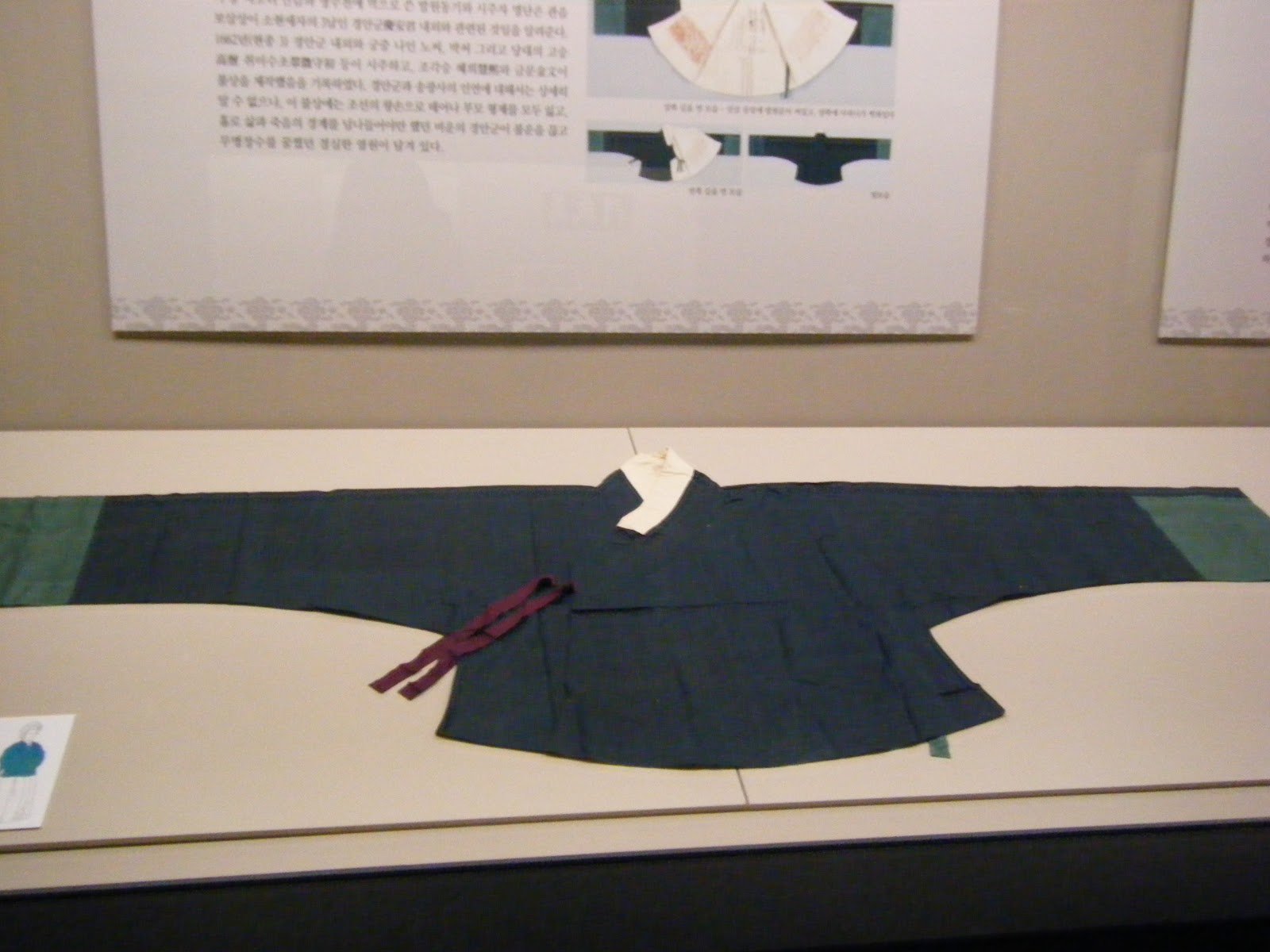
Relics found in Bodhisattva statue of Song-guang Temple


順天 松廣寺 腹藏 遺物

순천 송광사 복장 유물 전시회 (국립 고궁박물관)


Discovery of relics in a wooden Bodhisattva statue of Song-guang Temple in Suncheon 
(National Palace Museum of Korea)


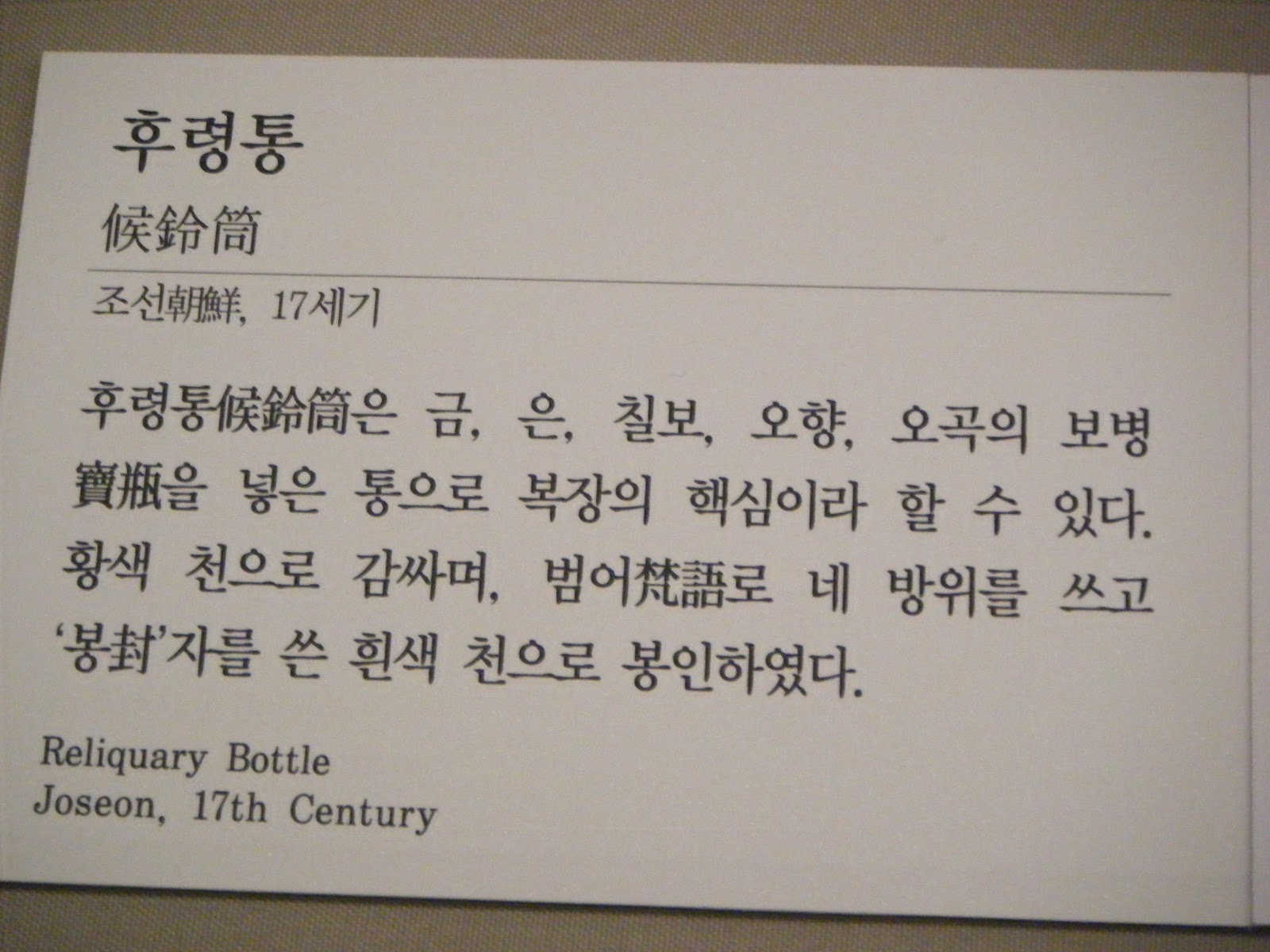
Bok-jang-yu-mul refers to 'relic in the Buddhist statue' in Korean.
Ancestors put valuables into Buddhist statues after making them, praying for their health and happiness.


In 2009, Joseon Dinasty's bok-jang-yu-mul were found in a wooden Bodhisattva statue in Song-guang Temple, Suncheon.

the donor were two court ladies(宮女), Ms.Noh and Ms.Park, who had served Prince Gyeong-an(1644-1665). 

They created this wooden Bodhisattva statue praying for longevity of Prince  Gyeong-an  and his wife in 1662.

However, Prince Gyeong-an died young in 1665.

Prince Kyung-an's father was So-hyeon(소현세자) who had been dragged to China after the invasion by Ching China(淸) in 1636, So-hyeon could be back to Joseon afterwards but died suddenly in 1645.(His death is now believed to be conducted by his father King In-jo, who feared his son's new ideologies)

Along with So-hyeon's death, his wife, Gang-bin(강빈), falsely accused of putting poison into king's food and executed leaving her three sons.

However, survived three sons, including Prince  Gyeong-an, unfortunately, all died in their early ages.


Few months ago, very popular Korean TV drama "Chu-no(追奴)" had dealt with this story,
so this exhibition made my heart more painful to his life.